Spotlight · May 18, 2026 · 4 min read
Kotor Cats Museum
Kotor's specialist museum for cat art and cultural archives, inside a former Poor Clares monastery within the Old Town walls.
Italian collector Piero Pazzi assembled the archive from a Venetian cultural fund and a private donation, and established it permanently in Kotor in 2013. Around 1,500 items span the 16th century to 1970.


“The museum has helped make the cat a new symbol of Kotor.”
The cats of Kotor

The cats have been in Kotor longer than most of the buildings. The town's position as a major Adriatic trading port brought generations of merchant ships into the bay, and with them cats, kept aboard to manage rodents in the cargo holds. When the ships docked, some cats stayed. Over centuries the population became part of the fabric of the city, visible on every square and alley inside the walls, and documented in the town's art and folklore as naturally as the sea or the stone.
Kotor has acknowledged this formally. The municipality maintains arrangements for the care of the town's resident stray population, and the Old Town itself, with no cars and no unleashed dogs inside the walls, functions as a semi-protected habitat. The Cats Museum, in operation since 2013, is connected to the same tradition. In the founder's words: "It is hoped that, through a love of cats, respect for nature and animals will grow among tourists."
The cats are not a tourist confection. They are a documented feature of the town's history, present in the records from the centuries when Kotor was one of the more significant ports on the eastern Adriatic. The museum is where that record has been gathered and organised for public access.
The museum

Piero Pazzi, an Italian art expert and collector from Venice, opened the museum at Stari Grad 371 in 2013. The founding collection was drawn from two sources: the International Centre for Adopting Cats Badoer in Venice, and a private donation from Countess Francesca Montereale di Mantica. Pazzi had assembled additional material over many years before bringing the combined archive to Kotor as its permanent home. The building is the former refectory of the Poor Clares monastery of Our Lady of the Angels. The Poor Clares, the female branch of the Franciscan order, occupied this site within the Old Town walls; what remains is the stone refectory, a single large room typical of medieval monastic dining halls, which now holds the displays. The square outside, Trg Gospa od Anđela, takes its name from the same monastery. The museum occupies two rooms and a connecting corridor. Most visits run between fifteen and thirty minutes. No advance booking is required. There is at least one resident cat, documented consistently by visitors. Current hours are confirmed at catsmuseum.org.
The collection

Around 1,500 items span four centuries, from the 16th century to 1970. The geographic range is broad: Italian, Austro-German, Spanish and French material is most strongly represented, assembled from European sources rather than focused on the Adriatic or Montenegrin context specifically. The types cover antique books and manuscripts, engravings and prints, coins and medals, illustrated postcards from 1891 to 1950, greeting cards, old photographs, film posters, sheet music and record sleeves, vintage newspaper and magazine pages, postage stamps, old advertisements, and children's school items. Among the named artists represented are Francesco Piattoli and Gottfried Mind, the latter known specifically for his cat illustrations.
Two thematic sections are dedicated to the cat's place in documented history rather than art. One covers cat shows in Europe before the First World War, a period when competitive cat breeding and exhibition became fashionable in Britain and France. The other is titled "The Cat in World War I" and documents the use of cats by soldiers in the trenches, including photographs and cartoons from the period. Japanese hand-coloured postcards and anthropomorphic imagery depicting cats in carriages or military costume are among the more unusual items.
The collection ends at 1970, excluding contemporary and post-war mass-produced material. The cut-off keeps the focus on a period when cat imagery carried cultural weight in illustration, typography and decorative art beyond simple domesticity. What distinguishes the material from a general curiosity collection is the documentary intent: the items are catalogued and curated rather than assembled for atmosphere, and the archive is built around two significant institutional donations rather than accumulated informally.
A visit to the Cats Museum is an opportunity to introduce tourists to the cultures of various countries through works of art from the past.
Worth knowing
Open May to October
Operates seasonally from 1 May to 31 October. Closed for winter with no regular public access outside these dates.
Trg Gospa od Anđela
On the square of Our Lady of the Angels, under five minutes on foot from the Sea Gate. One of the quieter squares inside the Old Town walls.
Contact
+382 68 628 582 · info@catsmuseum.org · catsmuseum.org · instagram.com/explore/locations/342356931
Budapest sister museum
A second Cats Museum, founded by the same collector Piero Pazzi, operates in Budapest. The Kotor branch opened first, in 2013.
Entry supports stray cat care
A share of the entrance fee goes toward food for the stray cats living in the Old Town.
Nominations open
Spotted something in the Old Town that shouldn't stay under the radar?
One spotlight a week, chosen by hand. Owners, locals and visitors are all welcome to nominate.
Kotor Spotlight
 Spotlight
360 Monte
Bay cruises, national park tours and Tara River rafting from a walk-in office inside the Old Town walls since 2015.
 Spotlight
Heritage Boutique Hotel Palazzo Radomiri
A Venetian-era captain's mansion in Dobrota, restored as Montenegro's first heritage boutique hotel, with a private jetty on the bay.
 Spotlight
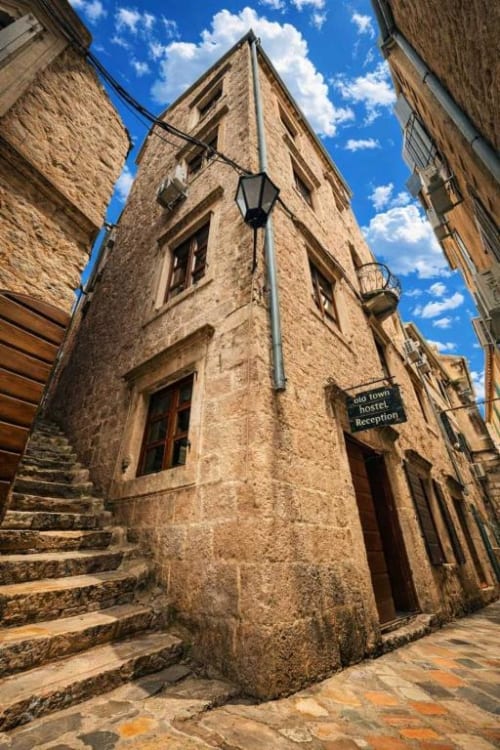
Hostel Old Town Kotor
A highly rated hostel inside a 13th-century Bisanti noble building, with 34 organized activities and kitchens in every room.
 Spotlight
Mövenpick Hotel & Residences Teuta Kotor Bay
Five-star resort on the Risan Carine shore. Hotel rooms, branded residences, private beach and the Trivona Wellness Center.