
Despite its dense concentration of settlements and long history of maritime exchange, the Bay of Kotor never developed into a single unified city centred on Kotor. This outcome stands in contrast to many Adriatic bays where dominant ports gradually absorbed surrounding communities. In Kotor’s case, the persistence of separation was shaped by medieval fortification, legal boundaries, land ownership patterns, and the absence of structural pressure toward urban consolidation.
From the medieval period onward, Kotor functioned as a fortified urban commune with clearly defined walls, jurisdiction, and civic institutions. By the 12th century, the town had established itself as an episcopal seat and administrative centre, but its authority was spatially confined. The town walls were not simply defensive structures; they defined legal inclusion and exclusion. Rights, obligations, and governance applied fully inside the walls, while areas beyond them fell under different regimes. This rigid boundary prevented gradual suburban absorption, a key mechanism through which unified cities typically emerged elsewhere.
Expansion outside the walls occurred early, but not as urban growth. Areas immediately adjacent to Kotor, including Škaljari and Muo, developed as separate settlements with their own land use patterns and communal organisation. They served agricultural, maritime, and transit functions but were not incorporated into the town’s legal framework. The distinction between the fortified town and its surroundings remained intact throughout the medieval and early modern periods.
Land ownership patterns reinforced this separation. From the late medieval period onward, elite families invested heavily in coastal property outside Kotor’s walls. Along the eastern shore, Dobrota developed as a linear settlement characterised by family estates, churches, palaces, and private quays distributed along the shoreline. Wealth and influence were therefore not concentrated exclusively within Kotor’s urban core. Instead, economic power was dispersed across multiple coastal communities, reducing incentives for political or administrative unification.
Maritime geography further limited centralisation. The bay contains numerous sheltered anchorages rather than a single dominant harbour. Settlements along both shores had direct access to navigable waters, allowing trade and communication without passing through Kotor. Towns such as Perast and Prčanj developed strong maritime identities and external connections of their own. Their economic and social orientation was not dependent on Kotor’s port, preventing the emergence of a single maritime choke point.
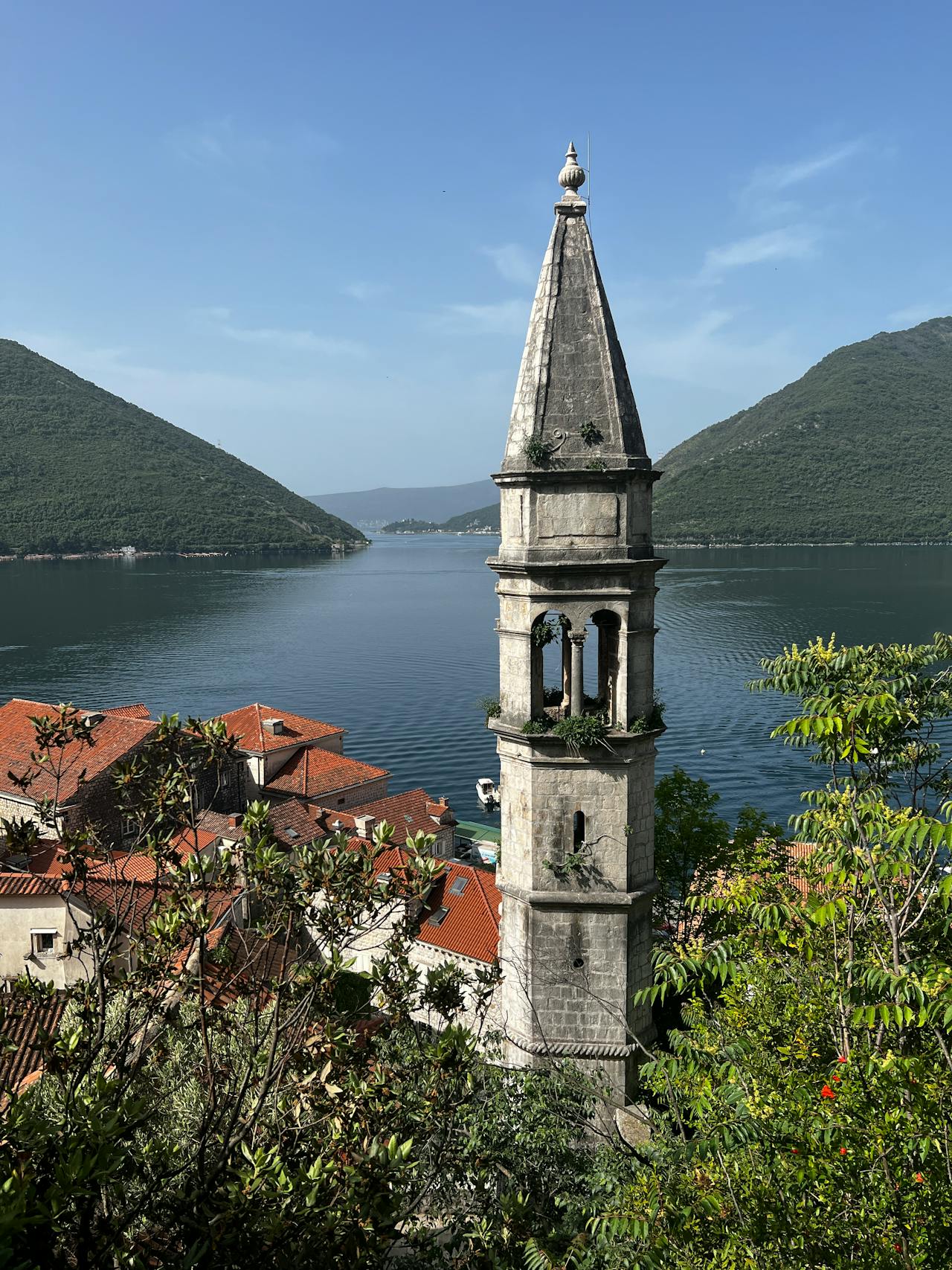
Administrative fragmentation played an equally important role. Throughout the period of Venetian rule from 1420 to 1797, the bay was governed as a collection of distinct communes rather than a unified municipality under Republic of Venice. Venetian administration prioritised stability and local continuity over territorial consolidation. Existing communal boundaries were largely preserved, reinforcing separation rather than integration. Kotor retained its status as a fortified town and administrative centre, but surrounding settlements were not absorbed into its civic structure.
Religious organisation mirrored this decentralisation. While Kotor served as the seat of the Roman Catholic diocese, parish churches, monasteries, and confraternities remained tied to specific settlements. Religious life reinforced local identity rather than regional unification. Even shared devotion did not translate into shared governance or urban consolidation, as ecclesiastical jurisdiction did not override communal autonomy.
Economic specialisation further stabilised this arrangement. Fishing communities, maritime traders, agricultural producers, and shipowners operated across settlement boundaries through exchange rather than hierarchy. No single settlement monopolised economic activity across the bay. Instead, complementary roles emerged, allowing Kotor, Dobrota, Perast, and Prčanj to coexist without one subsuming the others.
Geography reinforced these dynamics rather than counteracting them. These dynamics were reinforced by the bay’s geography and access constraints, which limited inland expansion and shaped movement between settlements. Steep mountains constrained overland integration, while enclosed waters enabled frequent lateral contact without funneling activity toward a single centre.
Later political regimes did not fundamentally alter this structure. Under the Austro-Hungarian Empire, infrastructure improvements increased connectivity, but they followed existing settlement patterns rather than reorganising them. Roads traced the shoreline, ports remained dispersed, and administrative divisions persisted. Modern governance inherited these historical boundaries rather than dissolving them.
In the contemporary period, tourism and cartographic convention have created the impression of a single destination centred on Kotor. This perception reflects branding and convenience rather than historical reality. The settlements around the bay did not fail to unite; they were never structurally compelled to do so.
The Bay of Kotor never became a single city because the forces that typically drive urban consolidation—unrestricted expansion, centralised authority, and monopolised access—were absent. Fortifications imposed limits, land ownership dispersed power, maritime access eliminated dependency, and administration remained fragmented. These conditions produced a stable system in which multiple settlements could thrive without being absorbed.
Understanding this history is essential for interpreting Kotor’s relationship to its surroundings. It explains why neighbouring places followed different trajectories, why boundaries mattered, and why the bay remains a collection of related but independent settlements rather than a single urban organism. In this case, what did not happen is as revealing as what did.